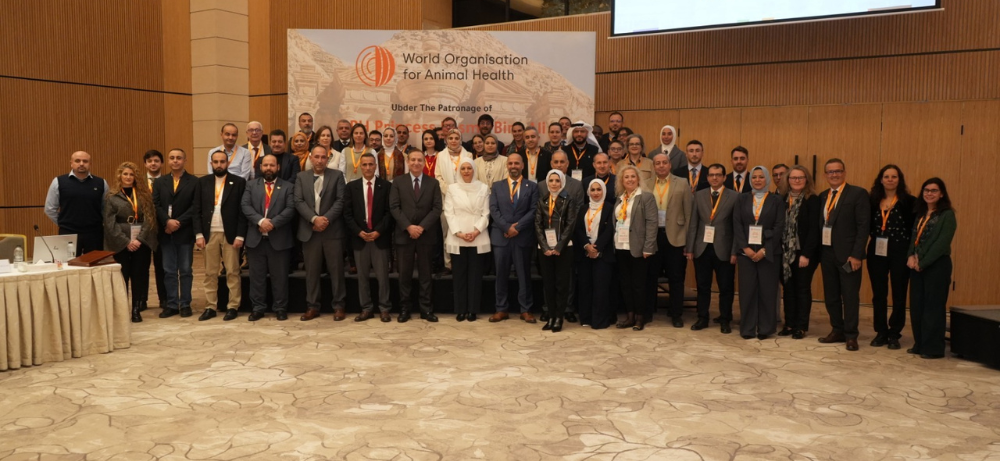
The multi-regional Whole Journey Scenario (WJS) workshop on long-distance transport by land and sea between Europe, the Middle East, and North Africa was held 13 – 15 January 2026, in Amman, Jordan.
The main objectives of the workshop were to help countries improve animal welfare during long distance and cross-border transport in compliance with WOAH standards for the whole duration of the journey along the selected route, with a focus on the responsibilities of the Competent Authorities over the entire journey.
The approach is based on bringing together all stakeholders involved in the transport of live animals, from the departure point to the final destination, to develop a common understanding and implementation of WOAH animal welfare standards.
The workshop addressed route-specific issues to ensure the welfare of animals during transport by land and sea and aimed to strengthen participants’ understanding of the relevant WOAH standards (Chapters 7.2 and 7.3 of the WOAH Terrestrial Code), with particular emphasis on the responsibilities of each stakeholder involved and the required exchange of information between the various Competent Authorities. The workshop gave an opportunity to build understanding of the animal welfare situation in participating countries, identifying key issues, constraints and challenges related to the implementation of WOAH standards. In addition, the workshop facilitated the sharing of best practices and strengthened collaboration among Competent Authorities. A dedicated session on animal welfare during slaughter will also be included to raise awareness of updated standards (Chapter 7.5 of the WOAH Terrestrial Code).
Representatives from 19 WOAH Members participated in the workshop, namely: France, Ireland, Portugal, Romania, Spain, Germany and Türkiye (Europe); Jordan, Lebanon, Syria, Kuwait, Iraq, United Arab Emirates (Middle East); and Egypt, Libya, Morocco and Tunisia (North Africa) and along with representatives from Brazil and Uruguay as well as the European Commission, veterinary professionals, business operators, producers and animal welfare organizations.
The workshop underscored the need to enhance and strengthen communication and collaboration among all stakeholders involved in live animal transport, highlighting the importance of well-defined responsibilities, proper planning, and a collective, adaptable approach in unexpected situations.
The workshop was thanks to financial support from the European Union and Ireland and kindly hosted by the Kingdom of Jordan under the patronage of HRH Basma Bint Ali.
As part of its continuous efforts to support the implementation of WOAH standards, since 2018, WOAH has organised a series of WJS workshops at the regional level (Europe in 2018; the Middle East in 2019) and subsequently expanded to the multi-regional level, starting with an online meeting for Europe and the Middle East in 2021, followed by in-person multi-regional workshops for Europe, the Middle East and North Africa (Cairo, Egypt, in 2022 and Tunis, Tunisia, in 2023).
| Day 1: 13th January 2026 | |
| Opening Session | |
| Welcome and opening | WOAH Regional Representative for the Middle East
WOAH Director General (video message) Ministry of Agriculture – Jordan HRH Princess Basma bint Ali |
| Session 1: Setting the scene | |
| WOAH global animal welfare strategy and activities related to transport of animals. | Leopoldo Stuardo (WOAH Standard Department) |
| WOAH ad hoc Group on transport of animals (revision of TAHC Chapter 7.2 and 7.3) | Maria Correia (Portugal) |
| WOAH animal welfare regional platform and strategies and activities related to transport of animals. | Tomasz Grudnik (WOAH SRR Brussels)
Faycal Meziani (WOAH RR ME) Francesco Valentini (WOAH SRR NA) |
| Session 2: Understanding country’s situation and identifying key challenges | |
| Export of live animals: Challenges and perspectives | Stanislav Ralchev (European Commission) |
| WOAH Members Countries presentations (overview of state of play – legislation, main trading partners main challenges): | |
| Brazil | Morocco |
| Day 2: Wednesday 14th January | |
| Session 3: Addressing the challenges and best practises | |
| Working group exercises – case study
– Presentation (15 min) – Group work (45 min) Reporting (10 min each group) |
All (4 groups) |
| Transport company perspective – A ship manager’s reality | Issa Awad Hasan (Sheraa Transport & Ship Management Co.) |
| Practical welfare control across the whole livestock journey | Amin Al Qawasmeh (Sheraa Transport & Ship Management Co.) |
| Animal welfare through a sea journey | Renee Willis |
| Business operator perspective – European Livestock and Meat Trading Union | Carolina Cucurella (UCBCVE) |
| NGO perspective Animals’ Angels | Silvia Meriggi (Animals’ Angels) |
| Animal Transport Guides | Nancy De Briyne (Federation of Veterinarians of Europe) |
| Update on EU activities on transport of animals | Stanislav Ralchev (European Commission) |
| Session 4: Slaughter of animals | |
| WOAH TAHC Chapter 7.5 | Leopoldo Stuardo (WOAH Standard Department) |
| Session 5: From Insights to Actions | |
| Discussion, interactive session, conclusions and next steps | Moderator: Tomasz Grudnik (WOAH) |
| Closing remarks | WOAH |
| Day 3: Thursday 15th January | |
| Field visit (all day) – quarantine facilities | |