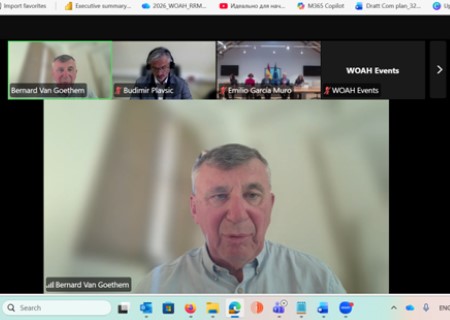
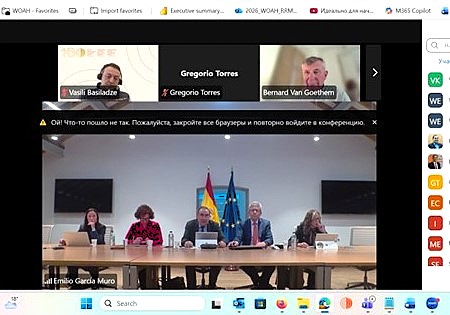
This second webinar on the situation in Spain, following an initial session held in December 2025 shortly after the first detection, responded to strong international interest and reaffirmed the importance of timely information sharing and coordinated action in managing transboundary animal diseases.
Opening the event, Dr Budimir Plavšić, WOAH Regional Representative for Europe, on behalf of Regional Secretariat of GF-TADs Europe, highlighted the role of GF-TADs as a long-standing coordination platform jointly established by FAO and WOAH, and chaired by the European Commission, facilitating rapid exchange of information and experience at regional and global levels.
In his opening remarks, Dr Bernard Van Goethem, President of GF-TADs for Europe, underlined that the ASF situation in Spain illustrates both the ongoing risks posed by the disease and the effectiveness of established European control frameworks. He commended Spain for its rapid notification, high level of preparedness, and transparent communication, noting that all measures implemented are in line with WOAH international standards and EU legislation.
Dr Emilio García Muro, Chief Veterinary Officer of Spain and WOAH Delegate, presented the latest epidemiological update. Since the first detection in November 2025 in Catalonia, ASF has been confirmed exclusively in wild boar populations, with no cases detected in domestic pigs.
As of mid-April 2026, 44 outbreaks involving 252 ASF-positive wild boars have been reported, all confined within restricted areas. Intensive surveillance, particularly through the detection of wild boar carcasses, has played a critical role in early identification and monitoring of the disease.
Spain has implemented a comprehensive set of control and eradication measures, including large-scale carcass searches, installation of physical barriers and fencing, establishment of “white zones” to reduce wild boar density, and strict biosecurity measures in pig holdings. These efforts have so far been effective in containing the spread of the virus.
Dr Manuel Durán Ferrer, representing the Spanish National Reference Laboratory, described the structure and functioning of Spain’s laboratory network, which includes 29 accredited laboratories coordinated by the national reference laboratory.
Rapid diagnostic workflows and close collaboration with the EU Reference Laboratory (EURL) for ASF have enabled timely confirmation and detailed characterisation of the virus. Advanced molecular tools, including PCR, partial sequencing of targeted genetic markers, are being used to monitor the outbreak and support epidemiological investigations.
Dr Carmina Gallardo from the EURL presented the results of molecular characterisation of the virus. The ASF virus detected in Spain belongs to genotype II but represents a previously undescribed genetic group, indicating a distinct introduction.
Whole-genome sequencing revealed unique genetic features, including a significant deletion affecting multiple genes and several mutations not previously reported. While the precise origin of the virus could not be determined due to gaps in available genomic data, the most likely scenario is a single, human-mediated introduction, potentially linked to contaminated pork products or food waste.
These findings underline the importance of strengthening genomic surveillance, expanding sequence databases, and enhancing international data sharing to improve outbreak tracing and preparedness.
Throughout the webinar, speakers emphasised that transparency in disease notification and the consistent application of control measures in line with WOAH international standards are essential not only for effective disease management, but also for maintaining trust between countries and safeguarding safe trade.
The event also highlighted the added value of the GF-TADs platform in facilitating dialogue, sharing experience, and supporting coordinated responses to transboundary animal diseases at regional and global levels.
Participants were encouraged to continue engaging through GF-TADs mechanisms and to apply the lessons learned from the Spanish experience to strengthen preparedness and response capacities in their own countries.
In his closing remarks, Dr Van Goethem pointed out that ASF remains one of the most important global transboundary animal diseases and that preparedness, information-sharing and coordinated action remain the most effective tools to protect animal health and safe trade.