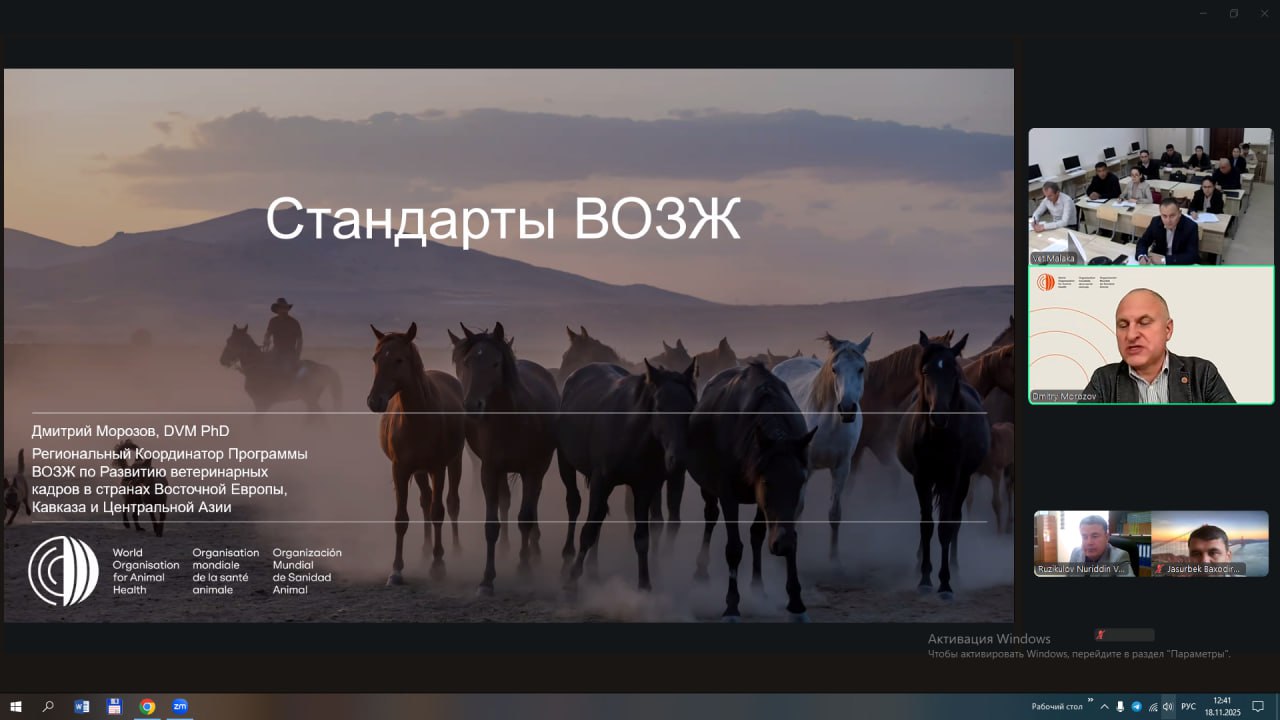
On 18 November 2025, the WOAH Sub-Regional Representation for Central Asia delivered an online lecture for the faculty teaching staff of the Samarkand State University of Veterinary Medicine, Animal Husbandry and Biotechnology and its branches in Tashkent and Nukus. The session focused on the role of WOAH international standards in ensuring animal health, their key components, procedures for their development and adoption, practical approaches to their use by various categories of veterinary professionals, as well as their application in education for undergraduate, postgraduate and doctoral students, and for continuing professional development.
The lecture was delivered by Dmitry Morozov, a staff member of the SRR who coordinates the WOAH Programme on Veterinary Workforce Development in Eastern Europe and Central Asia.
WOAH International Standards: A Foundation for the Global Veterinary System
During the lecture, it was highlighted that WOAH international standards are officially recognised by the World Trade Organisation (WTO) as reference documents in the field of animal health and zoonoses. These standards form the basis for ensuring safe international trade in animals and animal products, preventing the transboundary spread of diseases, and strengthening resilient veterinary services.
Particular attention was given to the structure of the following key standards:
Participants became familiar with the logic behind the structure of the standards and their role in risk management, disease notification, biosecurity, certification, animal welfare, and the quality of veterinary services.
How to Use the Standards in Professional Practice and Education
The speaker explained in detail how veterinary professionals can apply WOAH standards in their daily work, including:
Practical examples were provided using the Code to prepare veterinary certificates, assess a country’s disease status, understand the criteria for including diseases on the WOAH list, and plan preventive and control measures.
The lecturer also shared personal experience applying the Code in WOAH missions on veterinary legislation review, evaluation of national veterinary services, and veterinary workforce development.
The Importance of Integrating WOAH Standards into University Curricula
A key part of the lecture addressed the role of WOAH standards in modernizing veterinary education. It was emphasized that contemporary curricula must equip students with skills aligned with international professional expectations and the WOAH Day-1 Competencies for veterinary graduates.
Participants received recommendations on how to:
Continued Collaboration
At the end of the lecture, representatives of Samarkand University expressed their appreciation for the practical value of the material and their interest in continuing cooperation with WOAH on modernizing curricula, providing professional development for faculty teaching staff and veterinarians, and integrating international standards into veterinary education in Uzbekistan.
Recently, Samarkand University proposed an initiative for WOAH to designate it as a WOAH Regional Collaborating Centre for Veterinary Education and Workforce Development.
WOAH will continue supporting the development of the veterinary workforce in the region, strengthening educational programmes in veterinary institutions, and promoting the implementation of international standards to ensure the health and welfare of animals and people, as well as the resilience of agrifood systems.